Syringe Pump on Rent
Hire a syringe pump on rent for hospitals, ICUs, nursing homes and home care. Check single and multi-channel options, features and the latest rental charges in India.
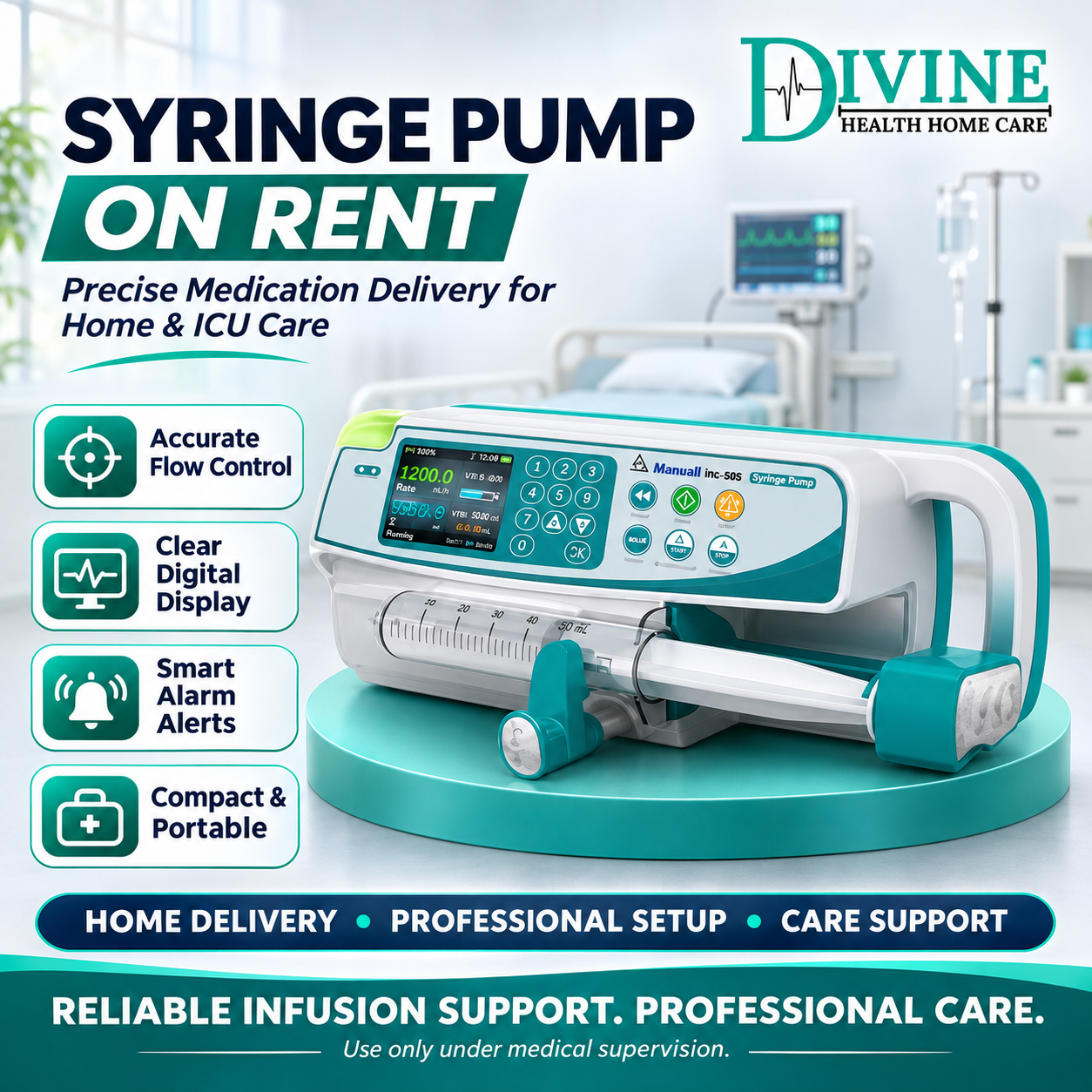
Updated on 22 Nov 2026 | 4 min readThe Syringe Pump on Rent is a precision infusion device that delivers small, controlled volumes of fluid or medication from a syringe over a set time, under the direction of a doctor. It is rented for hospitals, ICUs, nursing homes, palliative care and supervised home care. Depending on the model, it may be single-channel or multi-channel, with alarms, a battery backup and compatibility with several syringe sizes. Divine Health Home Care offers syringe pumps on rent with delivery and setup assistance. Available models, features, rental periods and charges depend on the exact pump and configuration.
Many treatments need medication or fluid delivered slowly and accurately over hours or days. A syringe pump does this by pushing the plunger of a syringe at a controlled rate. Buying a pump can be costly when the need is temporary, such as for a short ICU requirement, a palliative care period or a home-care course. Renting lets a hospital, nursing home or family use the equipment for the period required.
A syringe pump is a medical device used under professional direction. It does not replace medical supervision, trained nursing care or the instructions of the treating doctor. The drug, dose, rate and duration must be decided and programmed by a qualified clinician.
A syringe pump, also called a syringe driver or infusion syringe pump, is an electronic device that holds a syringe and moves its plunger at a precise, programmed speed. This delivers a measured volume of fluid or medication over time through an infusion line connected to the patient.
Syringe pumps are well suited to low-volume, accurate infusions. Large-volume infusions are usually given with a different device, called a volumetric infusion pump. The right device for each patient is decided by the treating doctor.
The syringe is loaded into the pump and secured by clamps and a plunger holder. A motor-driven mechanism pushes the plunger at the rate the clinician sets. The pump monitors the process and raises alarms for conditions such as an almost-empty syringe, a blockage in the line, a loose syringe or a low battery.
Features, alarm limits and operation differ by manufacturer and model. Always follow the manual and the facility’s infusion protocol.